Grinders
How to Use a Grinder: Step-by-Step Guide
By Alex MelenUpdated 12 min read

In this guide
Quick answer: To use a herb grinder, take off the lid, break the herb into pea-sized pieces and place them between the teeth around the outer edge. Close the lid and twist it back and forth 8 to 12 times. Tap the side, then open the middle section to collect the ground herb.
Somebody hands you a grinder for the first time and it looks simple enough. There's a lid, some teeth, maybe a couple of extra sections that unscrew. Then you open it up and realize you're not sure where the herb goes, how full is too full, or what on earth the bottom compartment is for.
Don't worry, it takes about a minute to learn. Just so we're on the same page, this guide is about herb grinders, the small handheld kind with teeth inside that break dried herb into even pieces. It's not about angle grinders or coffee grinders. We'll cover the 2 piece, the 4 piece and the 5 piece, and a few small habits that make a real difference to the grind.
Why Grind at All?
You can break herb up with your fingers, and plenty of people do. The trouble is you end up with some big pieces and some small ones, and a mix like that doesn't pack evenly. A grinder gets everything to roughly the same size, so it's consistent and air can move through it. And the sticky residue stays on the teeth, not on your fingers, which is a nice bonus.
Parts of a 4 Piece Grinder
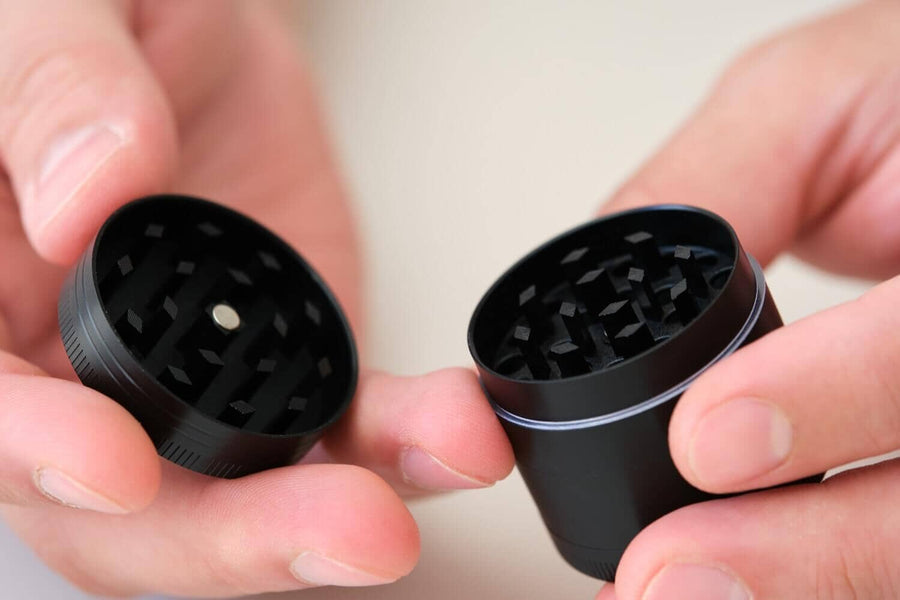
Once you know what each piece is for, the steps pretty much explain themselves. So let's start there. A standard 4 piece grinder is four sections stacked on top of each other.
- The lid. It has teeth on the underside, and on most grinders a magnet in the middle that holds it shut.
- The grinding chamber. More teeth, and holes in the floor for the ground herb to fall through.
- The collection chamber. This is where your ground herb ends up. The floor of it is a fine mesh screen.
- The kief catcher. That's the bottom section. The very finest powder sifts through the screen and builds up here over time.

The other types are variations on that. A 2 piece is just the top two sections with no holes, so everything stays in with the teeth. A 3 piece has a collection chamber but no screen and no kief catcher. And a 5 piece adds a storage jar on the bottom. Still deciding which one to get? Our guide to the types of herb grinders goes through the trade-offs.
How to Use a Herb Grinder, Step by Step
We've written these steps for a 4 piece, since that's what most people have. The differences for a 2 piece and a 5 piece come straight after.
- Take off the lid. On most grinders it's held on by a magnet and lifts straight off. Nothing needs unscrewing yet.
- Break the herb up by hand. You're aiming for pieces about the size of a pea. Pull out any thick stems while you're at it, because they don't grind well and they can jam the teeth.
- Load it around the edge, not in the middle. Tuck the pieces in between the teeth, in a ring. The center is usually where the magnet or the pivot sits, so anything you put there doesn't get ground. It just gets squashed.
- Don't overfill it. The lid should sit flat without you having to push it down. If it won't, take a piece out. A packed grinder is harder to turn, and the grind comes out uneven anyway.
- Put the lid on and twist. Hold the base in one hand and turn the lid back and forth with the other. Somewhere around 8 to 12 turns will do it. Changing direction stops the pieces from bunching up against the teeth. If it jams, open it and move things around a bit. You'll feel it go loose when it's done.
- Give it a tap. A couple of taps against your palm knocks loose whatever's stuck in the teeth, and it drops through the holes.
- Open the collection chamber. Unscrew the middle section and there's your ground herb, sitting on the screen and ready to use.

And that's it, really. Once you've got the feel for it, the whole thing takes less than 30 seconds.
How to use a 2 piece grinder
You load it, close it and twist it in exactly the same way. What's different is that there aren't any holes, so the herb stays in with the teeth the whole time. That actually gives you more control, because the grind depends on how many turns you do. Four or five leaves it coarse. Ten or more gets it fine. Then you lift the lid and tip it out. A 2 piece magnetic grinder is about the easiest kind to carry around and clean, since there's so little to it.

How to use a 4 piece grinder
The steps above are the 4 piece method, so if that's what you've got, you already know most of it. It helps to think of it as three jobs stacked on top of each other. The top two sections do the grinding. The third one catches the ground herb on a screen. And the fourth, underneath the screen, collects kief.
So the order goes like this. Load the top, twist, tap, then unscrew the third section to get at your herb. The good news is that you don't have to do anything for the bottom chamber to work. Every time you grind, a little fine powder sifts through the screen and lands down there, and it builds up slowly over a few weeks. Most grinders come with a small scraper for getting it out. A light tap on the side before you open up shakes a bit more through the screen, too.

How to use a 5 piece grinder
Think of a 5 piece as a 4 piece with a sealed jar screwed on underneath. You grind as usual, and whatever you're not using right away goes in the jar, so you don't have to carry a separate container. On our 5 Piece Storage Grinder that jar holds 3.5 grams.
The Kief Catcher: What It's For and How to Empty It
That bottom chamber is the part people ask about most, so here's what's going on down there. Kief is the fine, dusty powder that shakes loose from dried herb while you grind it. Under a magnifying glass it's mostly trichomes, the tiny hair-like growths that cover the surface of a lot of plants. They're small enough to fall through the mesh screen, and the ground herb isn't, so the screen sorts the two for you every time you grind.
You don't have to do anything to make it collect. It builds up a little at a time, and after a few weeks you'll see a layer on the floor of the chamber. Tapping the side of the grinder before you open it shakes a bit more through. A 2 piece or a 3 piece doesn't have a screen, so nothing gets separated and there's no kief catcher at all.
How to get kief out of a grinder
- Unscrew the bottom chamber and hold it over a clean sheet of paper, so whatever falls doesn't end up on the table.
- Use the scoop that came with it. The EZ Grinder comes with a small guitar-pick scoop for exactly this, and most 4 piece grinders include something similar. Scrape the walls and the corners in one direction and tip the powder onto the paper. Fold the paper and it pours wherever you want it.
- Tap the screen from above. Before you put it all back together, a few light taps on the rim of the collection chamber knock loose the powder that's stuck to the underside of the mesh.
- Don't dig at it with a knife. A metal blade scratches the aluminum and can tear the screen. If it's caked on, a few minutes in the freezer usually makes it come away more cleanly.
Nothing is building up in the bottom
Nine times out of ten the screen is clogged. Sticky residue fills the mesh, and then nothing gets through. Brush it out from both sides. On our Premium 4 Piece EZ Grinder the screen comes out completely: raise the handle, turn it counter-clockwise, and it lifts free. Herb that's too moist is the other usual cause, because it clumps instead of shedding powder. And if you've only had the grinder a week or two, give it time.
One more thing about the EZ Grinder. Its bottom piece is interchangeable with the ONGROK Storage Puck line, so you can unscrew the chamber and carry it on its own, or use it as a separate compartment for keeping something apart from the rest.
How to Get a Finer or Coarser Grind
With a 4 piece, the herb drops through the holes as soon as it's small enough, so the grind comes out fairly consistent without you doing much. You can still nudge it one way or the other, though.
Want it finer? Turn the grinder upside down while you twist. The herb stays up in the teeth and doesn't fall through, so it gets cut for longer. Flip it back over and tap it when you're done. Want it coarser? Do fewer turns, and stop as soon as the lid spins freely.
Which should you go for? As a rough guide, a medium grind is good for rolling. A slightly coarser one works better in a pipe, because it lets the air through. Finer isn't always better, though. Powder packs down tight, blocks the airflow and clogs up the screen, so stop before you get that far. And if it's turning to dust without much effort, the herb is probably too dry, and rehydrating it takes a day or two. If it's clumping and smearing across the teeth, it's too moist.
Why Is My Grinder Stuck? Common Problems and Fixes
The lid is hard to turn
Usually it's just overloaded. Take some out and try again. If it's stiff even when it's nearly empty, there's sticky residue on the rim or the teeth, and it's due for a clean.
The grinder is stuck and won't open
Residue gets into the screw threads and more or less glues the sections together. Hold the grinder in your hands for a minute to warm it up, then wrap a rubber band around it for grip and twist. Some people sidestep the whole problem by getting a grinder without long threads. Our Premium 4 Piece EZ Grinder opens with a quarter turn, and it does that whether the chamber's empty or packed.
Nothing is falling through to the bottom
The holes or the screen are clogged, so brush them out. That little brush that came in the box? This is what it's for.
The grind is uneven
That tends to happen when you load the center or drop in pieces that are too big. Smaller pieces, arranged in a ring, usually sort it out.
Keep It Clean and It Keeps Working
A grinder that gets brushed out every few uses hardly ever jams. Empty it, brush the teeth and the screen, and tap out anything loose. When it starts to feel sticky, it's time for a proper clean.
- Take it apart over a clean cloth and tip out anything loose.
- Put the pieces in the freezer for 30 minutes. Cold residue goes stiff, so it brushes off instead of smearing.
- Brush everything out. Spend the most time on the teeth, the rim and the screen.
- Soak the metal pieces in isopropyl alcohol for at least 20 minutes, then scrub off whatever's left with a stiff brush. An old toothbrush is ideal. This is for metal grinders only, since alcohol can damage acrylic and painted finishes. Take off any rubber rings first, and keep it well away from flames.
- Rinse with warm water and dry it completely before you put it back together.
For the awkward spots a brush won't reach, the Accessory Cleaning Kit has the small brushes and tools you need. The full routine, including wood, acrylic and toothless grinders, is in our guide on how to clean a grinder.
Picking a Grinder That's Easy to Use
Buying your first one? A few things make it nicer to live with. Start with what it's made of. A metal grinder costs more than an acrylic one, but the teeth stay sharp and they don't snap off. Sharp, well-cut teeth matter more than you'd think, because they do the work so your wrist doesn't have to. A magnetic lid keeps everything shut when it's rattling around in a bag. And a screen you can take out turns cleaning into a two-minute job.
All of ours are cut from aircraft-grade aluminum, and you can see the whole range in herb grinders. If sticky herb is your biggest complaint, it's worth reading about toothless grinders. They mill the herb instead of cutting it, and there's nothing sharp inside for residue to cling to.
Herb Grinder FAQ
How do you use a herb grinder for the first time?
Lift off the lid, break your herb into pea-sized pieces and place them between the teeth around the outer edge. Put the lid back on, hold the base and twist the lid back and forth about ten times. Tap the side, then open the middle section to collect the ground herb.
Where do you put the herb in a grinder?
It goes in the top chamber, between the teeth, in a ring around the outside. Keep the center clear. That's usually where the magnet or pivot sits, and anything you put there gets pressed flat and doesn't grind.
How many times should you twist a grinder?
Around 8 to 12 turns is enough for most 4 piece grinders, and you'll feel it get easier as the herb drops through the holes. With a 2 piece grinder, fewer turns give you a coarser grind and more turns give you a finer one, so count to suit what you're using it for.
What is the bottom of a grinder for?
The bottom chamber is a kief catcher. The fine mesh screen above it only lets the smallest powder through, and that builds up over weeks of use. You don't have to do anything to make it work. Scrape it out now and then with the small tool that came with the grinder.
Do you need a grinder?
Not strictly. You can break herb up by hand or with scissors, but a grinder is quicker and gives you an even consistency, which is the whole point. It also keeps sticky residue off your fingers and saves the fine powder you'd otherwise lose.
How do you use a 4 piece grinder?
Take off the lid and place pea-sized pieces of herb between the teeth around the edge. Close it and twist about ten times. The ground herb drops through to the third section, which you unscrew to collect it. The bottom section, under the screen, catches kief and fills up on its own over time.
How do you get kief out of a grinder?
Unscrew the bottom chamber, hold it over a sheet of paper and scrape the walls with the small scoop that came with the grinder. Tap the rim of the screen from above to knock loose what's stuck underneath. Skip metal knives, which scratch the aluminum and can tear the mesh.
How often should you clean a grinder?
Brush it out every few uses, and give it a deeper clean about once a month or whenever the lid starts to feel stiff. Regular brushing is what keeps the screen clear and the sections turning easily.
Is this how you use a weed grinder?
Several customers report that our grinders work extremely well for that, but it isn't the intended use. ONGROK grinders are made for dry herbs. The steps are the same whatever you're grinding: load around the edge, twist about ten times, tap, and open the collection chamber.
ONGROK products are not meant to be used for any illegal purpose.