Gummies & Edibles
How to Store Edibles (and Can You Freeze Them?)
By Mubashir SiddiqiUpdated 18 min read

In this guide
Quick answer: Keep edibles in an airtight, opaque container somewhere cool, dark and dry, ideally 60 to 70°F, and well away from the stove, the dishwasher and sunny windows. Gummies and chocolate are fine at room temperature for the short term. Anything made with butter, eggs or dairy goes in the fridge. For anything you won't get to for a while, freeze it wrapped tight with the air pressed out, then thaw it in the fridge without opening the container. Wherever they live, keep them in a child-resistant container, up high and out of sight.
We should own up to something first. The old version of this page said homemade gummies keep for three months in the fridge and six in the freezer. That doesn't match our own infused gummies guide, which says a few weeks in the fridge, and honestly a few weeks is the number we'd stand behind, since homemade gummies don't have any preservatives in them. So we rebuilt this page from scratch, and wherever the advice comes from somewhere other than us, we've linked to the source.
A quick word on where we're coming from, too. ONGROK doesn't make edibles. What we make is the gear that goes around them, things like gummy molds, silicone bags and child-resistant jars. We get asked about storage a lot, and the honest answer is usually a bit more boring than people expect, because it mostly comes down to air, heat and moisture.
What Actually Makes Edibles Go Off?
There are four things that do the damage, and they're the same four that go after any food in your cupboard. Air dries gummies out and makes baked goods go stale. Heat melts chocolate and can turn a whole bag of gummies into one big gummy. Light slowly fades color and flavor. And then there's moisture, which people tend to underestimate. It's what makes gummies sweat and go sticky, and it's also what lets mold get started.
So pretty much every tip on this page is just a way of keeping one of those four out. It's also why "just leave it in the kitchen" tends to go badly. Think about what a kitchen has in it: a stove, a kettle, a dishwasher and usually a sunny window. That covers three of the four right there.
Where to Keep Them: Cupboard, Fridge or Freezer
It helps to think of it as three shelves. Which one you use depends on what the edible is and how soon you're going to eat it.
The cupboard is fine for anything shelf-stable you'll get through in the next week or two, so store-bought gummies, hard candy, and chocolate if your house stays cool. Just pick one that isn't next to the oven or above the dishwasher. The bathroom's out too, since it gets steamy every morning. Honestly, a closet or a bedroom drawer is often cooler and darker than anywhere in the kitchen.
The fridge is where anything with butter, eggs, milk or cream should go, along with homemade gummies and, when the house gets warm in summer, chocolate. The catch? A fridge is damp and full of smells. So whatever goes in there needs a container that properly seals, and a twist-tied bag won't cut it.
Then there's the freezer, which is for the long haul. If you've made a big batch, or you know you won't touch something for a month or more, it's the best place for it. We've given it its own section further down.
How to Store Edibles by Type
Different edibles go wrong in different ways, so here's the short version before we get into the detail. Keep in mind these are general guidelines and not ONGROK product claims. And if a store-bought product has its own label, the label always wins.
| Edible | Best place | How long | Watch for |
|---|---|---|---|
| Store-bought gummies and hard candy | Cool, dark cupboard, sealed | Months; use the best-by date | Sticking together, sweating |
| Homemade gummies | Fridge, airtight | A few weeks | Mold, wet surface |
| Chocolate | Cool cupboard; fridge only in hot weather | Use the best-by date | Melting, white bloom |
| Brownies, cookies, cakes | Fridge if made with dairy or eggs; freezer for longer | Days in the fridge, months frozen | Staling, mold |
| Infused oil (dried herbs) | Fridge, sealed | Up to three months | Rancid smell |
| Infused butter | Fridge; freeze in portions | Like regular butter | Picking up fridge smells |
| Alcohol tinctures | Dark glass, cupboard | A long time | Evaporation, loose cap |
Gummies
Store-bought gummies are the easy ones. They're made to sit on a shelf, so you can leave them in their original resealable pack. Just close it properly every time and keep it somewhere cool. The pack's also got the label on it, which matters more than you'd think (we'll get to labels further down).
So how long do store-bought gummies last? They're made to keep for months rather than weeks, but the only number that really applies to the pack in your hand is the best-by date printed on it. Each brand sets that date for its own recipe and packaging, which is why the figures you'll see quoted online run anywhere from about 3 to 12 months. That date assumes the pack stays sealed and somewhere cool and dark. Once it's open, close it properly every time, and if the gummies start going hard, sticky or smelling off before the date, trust what you're seeing over what's printed.
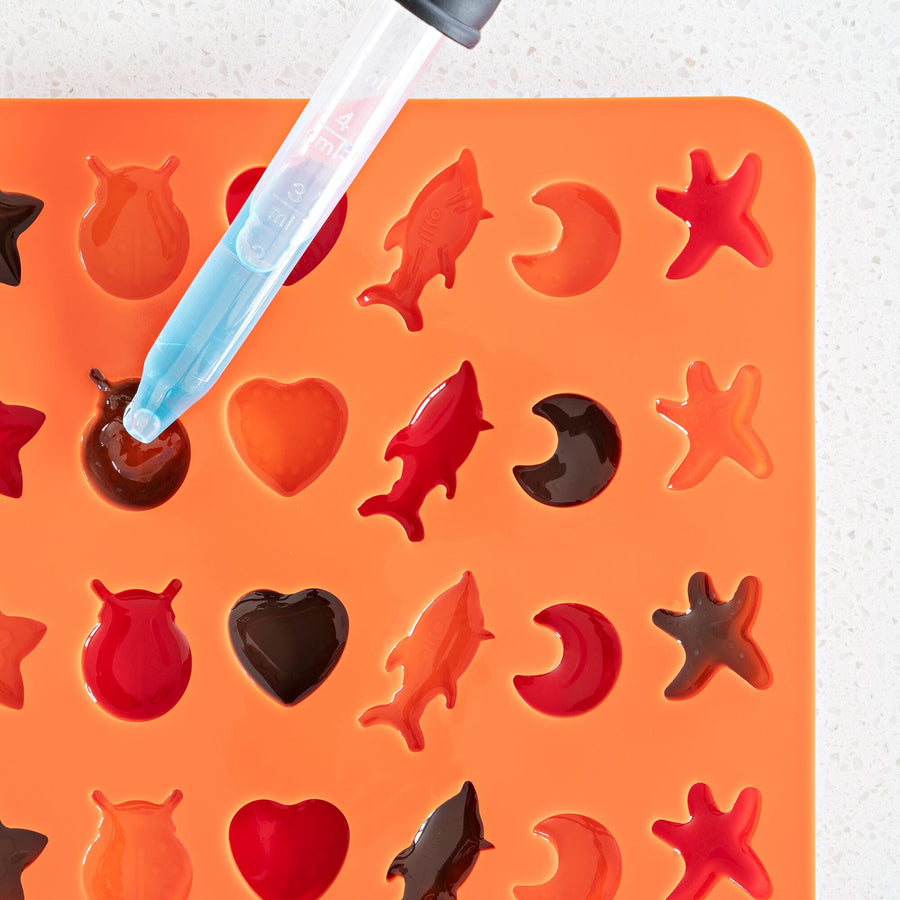
Homemade gummies are a different story. They don't have preservatives and they hold more water, so they belong in the fridge in a sealed container, where they're good for a few weeks. There's one step people tend to skip, and that's letting them dry out first. In our coconut oil gummies recipe we leave them out on parchment at room temperature for about 24 hours before they go into a container. If you seal them straight out of the mold, the surface moisture has nowhere to go, and you'll open the jar to a damp, sticky clump.
Got more than one batch going? Keep each one in its own container. That way you always know which is which, and if one batch goes off it doesn't take the other with it.

Chocolate
Chocolate really doesn't like warmth or damp. Warmth softens it, and if it melts and then sets again you'll often get a pale, streaky surface called bloom. Damp, whether it's from the fridge or from condensation, can leave a dry, dusty-looking white film. Both of those are about looks and texture. Bloom on its own isn't mold, either, and mold looks fuzzy rather than powdery.
So the cupboard is the first choice. But when summer means your house sits above the low 70s, move chocolate to the fridge in a sealed container. When you take it back out, give it some time on the counter before you open the container, so water doesn't condense on it.
Brownies, cookies and other baked goods
Treat these just like regular baking, because that's pretty much what they are. If there's butter, eggs or milk in them, the usual food safety rules apply. The USDA's Danger Zone guidance is to never leave perishable food out of the fridge for more than 2 hours, or 1 hour once it's above 90°F. So a tray of brownies left on the counter overnight isn't really a storage method.
For anything you won't finish in a few days, cut it into single pieces before it goes in the freezer. Then you only ever take out what you need, and nothing ends up getting thawed and frozen over and over.

Infused butter and oil
Infused butter and oil are the base for a lot of other edibles, and this is where storage starts to be a safety question as well as a taste one. Penn State Extension's guide to making infused oils safely explains the risk. Oils infused with fresh herbs or garlic can let botulism spores grow at room temperature. The guide gives two options: refrigerate those and use them within 2 to 4 days, or make the oil with dried herbs and refrigerate it for up to three months. Our tincture guide uses the same three-month figure for oil.
Infused butter keeps like regular butter. Whatever you're using right now goes in the fridge in a sealed container, because butter soaks up fridge smells fast. And the rest? Freeze it in small portions. A silicone mold works well for that, since the frozen blocks pop straight out.
Tinctures
Alcohol tinctures are the hardest edible to ruin. Keep them in dark glass in a cupboard, with the cap screwed on tight. What usually kills a tincture is a loose cap, because it lets the alcohol evaporate. Oil and glycerin tinctures are a bit different. They behave more like the infused oil above, so they live in the fridge.
Can You Freeze Edibles?
Yes, and for anything you won't eat soon it's honestly the best option you've got. The USDA puts it plainly in its freezing and food safety guide: "Food stored constantly at 0 °F will always be safe. Only the quality suffers with lengthy freezer storage." That's worth knowing, because most guides quote six to twelve months as if it were a safety limit. But it isn't one. It's about texture and flavor, so the real limit is how long you're happy with how they taste.
In the freezer, the thing working against you is air. The same USDA guide says freezer burn "is caused by air coming in contact with the surface of the food". So here's how we'd freeze gummies:
- Let them dry for a day if they're homemade, so you're not freezing surface moisture.
- Spread them out on a tray or a sheet of parchment and freeze them in one layer until they're hard. The USDA's advice is the same for any food: don't stack things until they're frozen solid. Done this way, they won't freeze into a block.
- Move them into a freezer-safe container or bag and press out as much air as you can. Small containers you'll fill beat one big half-empty one.
- Write the date and what's inside on the outside, and put the label from the original pack in with them.
Thawing is where most people go wrong. Take the sealed container out of the freezer and put it in the fridge, and don't open it until the edibles have come up to temperature. If you open it while it's still cold, the room's moisture condenses on the cold gummies and they go wet and sticky. Baked goods work the same way, so thaw them in the fridge, still wrapped. And please don't microwave anything to speed it up.
What about refreezing? A lot of guides say never, but the USDA is a bit more relaxed. Food thawed in the fridge "is safe to refreeze", though "there may be a loss of quality". Anything that's been left out of the fridge for more than 2 hours shouldn't go back in. So refreezing is safe, it just won't be quite as nice the second time around. If you freeze in single portions, it rarely comes up anyway.
Do Edibles Need to Be Refrigerated?
Some do and some don't. Store-bought gummies and hard candy don't, and the fridge can actually make them worse, since they pick up moisture every time the cold container meets warm air. Homemade gummies, baked goods with dairy or eggs, infused butter and infused oil do need it. Chocolate sits somewhere in between and only needs the fridge when your house is warm.
Does the fridge ruin edibles? Not if they're sealed. What does the damage is an open bag or a loose lid, which lets in damp air along with the smell of whatever's on the next shelf. A properly airtight container takes care of both.
Picking the Right Container
You're looking for three things: airtight, opaque, and roughly the right size. Airtight keeps air and moisture out, and opaque (or at least frosted) keeps the light off. Size matters because a half-empty container is mostly air, and whatever's inside just sits in it.
Glass jars with a sealed lid are the all-rounder. Our child-resistant jars are UV-resistant frosted borosilicate, and there's a gasket under the push-and-turn catch on the lid, so the jar is sealed as well as hard for a child to open. They come in 80ml six packs, 180ml three packs and 500ml two packs. The small sizes suit gummies well, because one batch fills one jar. We haven't published freezer guidance for them, though, so we'd keep them to the cupboard and the fridge.
Silicone bags are the option for the freezer and fridge. Our Silicone Oven & Storage Bags are food-safe silicone and freezer safe, and they seal properly instead of relying on a press-close zip, which matters in a fridge full of smells. Wondering how silicone stacks up against plastic freezer bags? We wrote up PEVA vs silicone separately.
If you'd rather get rid of the air than just seal it in, the Vacuum Pump Jar 2.0 pumps it out through the lid. That comes in handy for something like a big batch of cookies that's going to sit in the cupboard for a few days. And if you want to keep portions separate and labelled, color-coded mylar bags are opaque and have a label printed on the front.
Live somewhere humid? A food-grade silica gel packet, the little "do not eat" sachet that comes in jerky or seaweed snacks, can go in the container to soak up stray moisture. It's handy for store-bought gummies and hard candy kept in a cupboard. Don't mix it up with the 2-way humidity packs we sell for flower, though. Those are built to add moisture when the air is dry as well as take it out, and adding moisture is the last thing a gummy needs. And since a silica packet isn't something a kid or a pet should get hold of either, it lives in the same child-resistant container as the edibles.
What should you skip? Thin sandwich bags, since they aren't airtight, and clear containers left in daylight. Most of all, skip anything that looks like it holds normal food or candy, which is what the next section is about.

Keep Them Away From Kids and Pets
Of everything on this page, this is the part that matters most, and it's the part most other guides rush through in a single line. An infused gummy looks exactly like a regular gummy. A child can't tell the difference, and neither can a dog.
And the numbers are hard to ignore. A 2023 study in the journal Pediatrics looked at US poison center data for children under 6 who got into edibles. Reports went from 207 in 2017 to 3,054 in 2021, an increase of 1,375%, and 97.7% of them happened at home. So the risk isn't really out in the world somewhere. It's on the kitchen counter.
Child-resistant packaging helps, but it's worth knowing what the label actually promises. The US Consumer Product Safety Commission's guide to poison prevention packaging describes how the testing works with children aged 42 to 51 months. It also says outright that a package can pass without stopping every single child: "This is why the packaging is called child-resistant and not childproof." So a child-resistant lid buys you time, but you still need to put the jar somewhere they can't reach.
Here's what we'd do, and none of it is complicated:
- Keep edibles in a child-resistant container, and close it every time, even if you're coming straight back.
- Put that container up high, or in a locked box or cabinet, and away from where the regular snacks live.
- Never decant edibles into a candy tin, a cookie jar or an old snack bag. Disguising them is how mix-ups happen.
- Label the container clearly so another adult in the house knows what it is.
- Have the number ready. If a child or a pet gets into edibles, call Poison Help on 1-800-222-1222, which is open 24/7. For a pet, call your vet. In an emergency, call 911.
Label Everything
Labelling sounds a bit fussy, right up until the day you find an unmarked container at the back of the freezer. Two months on, nobody remembers which batch it was or when it went in.
Write down three things: what it is, the date it was made or opened, and the date it went into the freezer if it did. For store-bought edibles, keep the original label with them. If you move them into a jar, cut the label off the pack and put that in the jar too, because it's the only record of what's in each piece. Our jars come with labels and chalk, the vacuum jars come with chalkboard stickers and a marker, and the mylar bags have a write-on label printed on the front, so you've pretty much got it covered whichever one you use.
How to Tell If Edibles Have Gone Bad
Use the same judgment you'd use on any food, because that's all it is. Throw it out if you see mold (fuzzy spots, usually white, green or blue), if it smells sour, musty or rancid, or if a homemade gummy has gone slimy or wet. Butter- and oil-based edibles let you know when they've turned, since rancid fat smells like old crayons or paint. And if you're in doubt, we'd just throw it out.
Other changes are only about quality. Gummies go hard or chewy as they dry out, chocolate gets a dull, pale bloom, and cookies go stale. None of that makes them unsafe. It does tell you the container wasn't sealed or the spot was too warm, though, so it's worth fixing before the next batch.
Do edibles expire? Store-bought ones carry a best-by date on the pack, so go by that. Homemade ones don't, which is exactly why a label with the date on it matters.
Edibles on the Go, and the Hot Car Problem
Honestly, a parked car is about the worst storage spot there is. It heats up fast in summer, it can freeze in winter, and the glovebox is the first place a curious kid looks. So we'd never leave edibles in there.
If you're carrying them, take only what you need in a small, sealed, child-resistant container, and keep it in a bag that stays with you. In summer, an insulated lunch bag stops chocolate from turning to soup. And remember the USDA's limit for anything perishable like brownies, which is 2 hours out of the fridge, or 1 hour once it's above 90°F.
What if your gummies melted into one lump anyway? Put the whole thing in the fridge for an hour or so and let it firm up again. Don't microwave it to "reshape" it. Also keep in mind that the pieces aren't evenly portioned anymore, so you can't tell what's in each one just by looking.
FAQ
Can you freeze edibles?
Yes. Freezing is the best way to keep edibles you won't eat soon. Freeze gummies in a single layer first so they don't stick together, then seal them in a freezer-safe container with the air pressed out and a date on it. The USDA says food kept at 0°F stays safe indefinitely, so the time limit comes down to texture and flavor rather than safety.
Do edibles need to be refrigerated?
Not all of them. Store-bought gummies, hard candy and chocolate in a cool house are fine in a dark cupboard. Homemade gummies, baked goods made with butter, eggs or milk, infused butter and infused oil should go in the fridge in a sealed container. If your home gets warm in summer, move chocolate to the fridge too.
Does putting edibles in the fridge ruin them?
Only if they're not sealed. A fridge is damp and full of food smells, so an open bag lets moisture and odors in and gummies go sticky. In an airtight container they're fine. When you take a cold container out, let it warm up before you open it so water doesn't condense on what's inside.
Can you refreeze edibles?
Yes, if they were thawed in the fridge. The USDA says food thawed in the refrigerator is safe to refreeze, with some loss of quality from the moisture lost in thawing. Don't refreeze anything that has sat out of the fridge for more than 2 hours. Freezing in single portions means you'll rarely need to.
How long do store-bought gummies last?
Usually months, but go by the best-by date on the pack. Each brand sets that date for its own recipe and packaging, which is why figures quoted online range from about 3 to 12 months. The date assumes the pack stays sealed and is kept somewhere cool and dark. If the gummies go hard, sticky or smell off before then, throw them out.
How long do homemade gummies last?
A few weeks in a sealed container in the fridge. They have no preservatives and more water than store-bought gummies, so they don't keep long at room temperature. Let them dry on parchment for about a day before sealing them. For anything longer than a few weeks, freeze them in a single layer first and then move them to a sealed container.
What is the best container for edibles?
An airtight, opaque container that's about the right size for what you're storing, so there's little air inside. A glass jar with a gasketed, child-resistant lid suits the cupboard and fridge. Food-safe silicone bags suit the freezer. Whatever you use, it shouldn't look like a candy or snack container.
Does freezing edibles make them stronger?
No. Freezing doesn't add anything to an edible. All it does is slow down the drying out, staling and moisture changes that spoil texture and flavor over time. We don't make claims about strength, and we haven't seen any good evidence for the idea that the freezer "boosts" edibles.
How do I keep edibles away from kids?
Use a child-resistant container, close it every time, and keep it up high or locked away, apart from regular snacks. Child-resistant isn't childproof, so the location matters as much as the lid. If a child does get into edibles, call Poison Help on 1-800-222-1222, open 24/7, or 911 in an emergency.
How do you store cannabis gummies?
The same way as any other gummy on this page. Keep them sealed in the original pack or an airtight, opaque container, somewhere cool and dark, ideally 60 to 70°F. Store-bought ones go by the best-by date; homemade ones belong in the fridge for a few weeks, or the freezer for longer. Because they look like ordinary candy, keep them in a child-resistant container, up high. ONGROK doesn't make cannabis products, and our gear isn't designed for them.
Can you freeze cannabis gummies?
Yes, using the same method as other gummies: freeze them in a single layer, then seal them in a freezer-safe container with the air pressed out and a date on it. Thaw them in the fridge without opening the container, so they don't go sticky. Freezing is about keeping texture and flavor; we don't make any claims about what it does to strength or effects.
Are ONGROK jars good for storing weed edibles?
Several customers tell us our jars work extremely well for that, but it isn't the intended use. ONGROK jars and bags are made for dry herbs and food. The storage rules don't change: airtight, cool, dark, labelled, in a child-resistant container kept out of reach.
The Short Version
So, to sum it up. Keep edibles airtight, cool, dark and dry, put anything with dairy, eggs or fat in the fridge, and use the freezer for anything you won't get to for a while. Thaw slowly and sealed, and don't open the container while it's cold. And whatever else you do, keep edibles in a child-resistant container that lives up high, with a label on it.
If you're making your own, our scored gummy molds break into even quarters, and our child-resistant stash jars keep the finished batch sealed. Flower plays by different rules, so for that one, see Does Flower Go Bad?
ONGROK products are not meant to be used for any illegal purpose. Always follow the laws where you live, and keep all edibles out of reach of children and pets.